
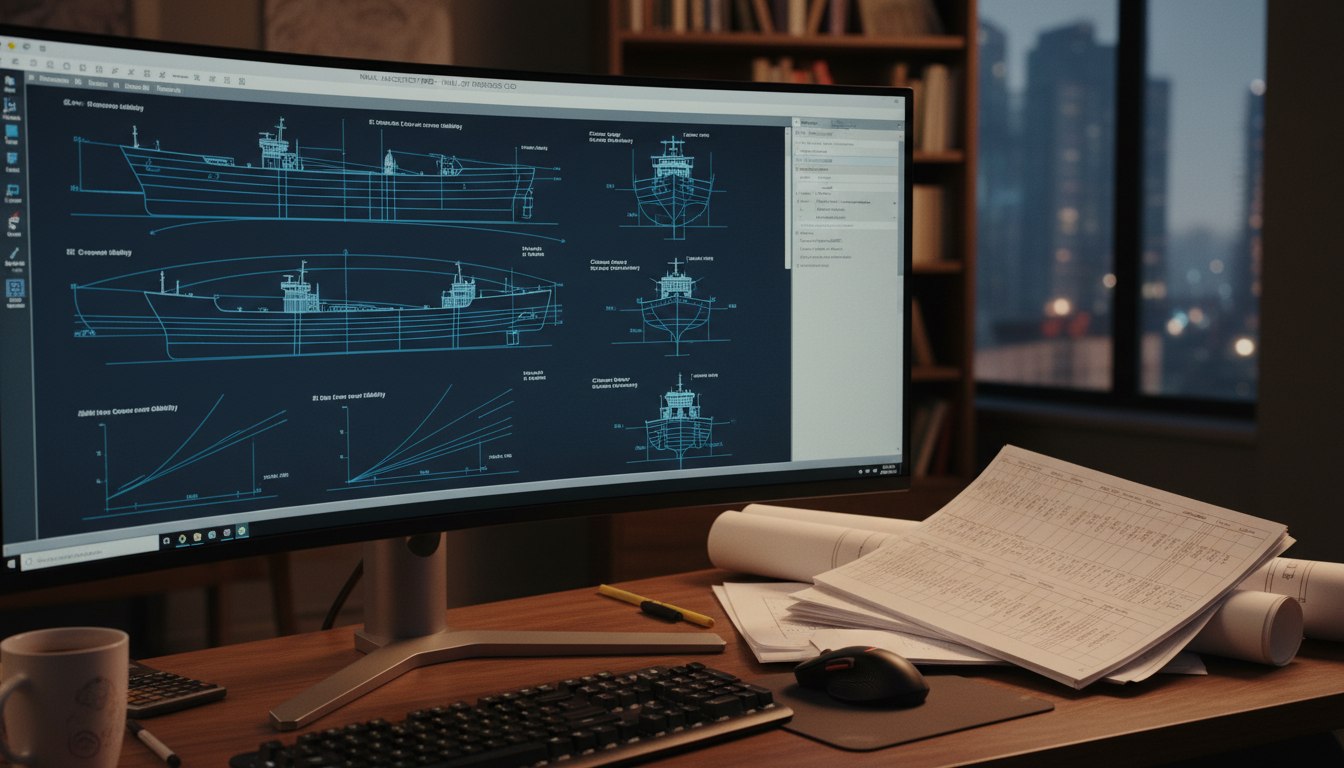
IACS Class Approved Loading Computer
NAVLOAD
Our own loading computer software. IACS class approved, built for any vessel that needs one, and tied to your approved stability data — so the bridge and the booklet always agree.
NAVLOAD — loading software that agrees with your booklet
Why a converted vessel often runs on a loading computer that no longer matches it.
IACS class approved
Not a prototype. Approved by an IACS member classification society as the loading instrument on a vessel in service.
- Approved by a member society of IACS
- In service aboard a vessel today
- Type 3 scope — damage stability by direct calculation, IACS UR L5
- We handle the submission and approval for your vessel
What it calculates
A full loading instrument, not a stability spreadsheet.
- Intact stability to IS Code 2008, including the weather criterion
- Damage stability by direct calculation of damage cases
- Still water shear force and bending moment against permissible limits
- Tank soundings, ullage and calibration tables
- Draft, trim, heel, KG, GM and GZ — in the form the crew works from
Any vessel type
NAVLOAD is not written for one ship type. Because the software is ours, we extend it wherever a vessel breaks the usual assumptions.
- Tankers, bulk carriers, container and general cargo ships
- Grain loading with heeling moment checks
- Barges, tugs, workboats and offshore support units
- Crane barges and heavy-lift platforms — lifting cases, ballast sequences, deck loads
Validated against your booklet
We publish the deviations rather than claiming accuracy. On the reference vessel, every booklet condition was run and compared.
- All 18 booklet loading conditions tested
- Every IS Code verdict matched the approved booklet
- Displacement within ±0.5% on every condition — maximum deviation 0.36 t
- Full deviation tables issued, not summarised away
Rebuilt when your vessel changes
A conversion, a BWTS, a crane foundation — the ship changes and the old loadicator quietly becomes wrong. We update it with the stability booklet, as one package.
- Dataset rebuilt after conversion, retrofit or lightweight change
- Revised tank definitions and permissible envelopes
- Re-verified and re-approved with class
- Geometry rebuilt from the lines plan, or from a 3D scan if drawings are gone
Try it yourself
Try NAVLOAD now
The real software, running in your browser. Fill tanks and watch the 3D hull, draft, trim, GM, stability criteria and still-water shear force and bending moment solve live — then generate the report.
Demonstration dataset on a generic product tanker. Hull form, tank geometry, hydrostatics and strength limits are real engineering data; no client vessel is identified. Best on a desktop screen — open full screen for the complete interface.
Frequently asked questions
Is NAVLOAD class approved?
Yes. NAVLOAD is IACS class approved — an IACS member classification society has approved it as the loading instrument aboard a vessel in service. Loading computer software is assessed against each individual vessel and its approved stability information, and we manage that submission for yours.
Which vessel types can it handle?
Any vessel that needs a loading instrument — tankers, bulk and grain carriers, container ships, general cargo, barges, tugs, workboats and offshore units. Because we own the software, unusual cases such as crane barges and heavy-lift platforms are built in rather than worked around.
How do we know the calculations are right?
We validate against the vessel’s own approved Trim and Stability Booklet and hand you the deviation tables. On the reference vessel all 18 booklet conditions were run: every IS Code verdict matched, and displacement agreed within ±0.5% on every one.
Our vessel was converted. Is the existing loadicator still valid?
Usually not. Any change to lightweight, centre of gravity, tank arrangement or permissible limits makes the dataset wrong, and the instrument keeps producing confident, incorrect numbers. It needs rebuilding and re-approving alongside the stability booklet.
What do you need to quote?
Vessel particulars and class society, the approved trim and stability booklet, the lines plan and capacity plan, and details of any modification since approval.
Related engineering services
Have a vessel and a scope in mind?
Share your drawings, class society and target dates — we respond within 24–48 hours.