
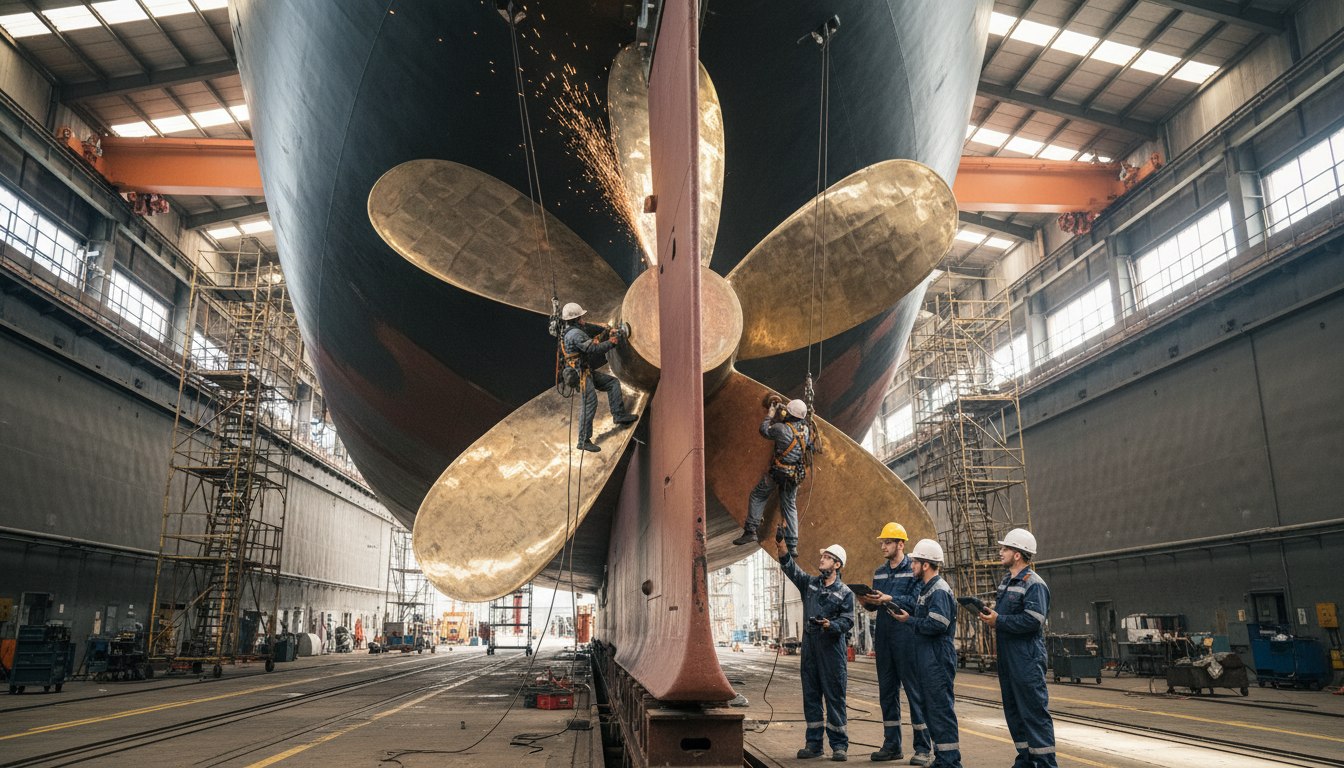
Energy Efficiency
Energy Efficiency, EEXI & CII
Navtech helps owners and managers meet IMO efficiency requirements without losing commercial performance — EEXI technical files, engine power limitation, CII rating improvement and the retrofit engineering that actually moves the number.
EEXI, CII and SEEMP — the complete file, one team
IMO DCS and CII reporting, SEEMP Part II and III, and the EEXI technical file with engine power limitation — prepared, submitted and followed up with class.
EEXI technical files and engine power limitation
The Energy Efficiency Existing Ship Index applies to the vessel as built, and most older tonnage does not pass on hull form alone. The usual route is limiting delivered power, but the limit has to be set carefully — too conservative and the vessel loses speed it still needs commercially, too tight and it fails in heavy weather.
- EEXI calculation and attained vs required index assessment
- EEXI Technical File preparation and class submission
- Engine Power Limitation (EPL) and Shaft Power Limitation (SHaPoLi) arrangement design
- Overridable limitation systems with the required recording arrangements
- Minimum propulsion power verification for safe manoeuvring in adverse conditions
CII rating and SEEMP Part III
Unlike EEXI, the Carbon Intensity Indicator is an operational measure — it is recalculated every year, and a vessel that passes today can drift into a D or E rating through nothing more than a change of trade. We model the rating against your actual trading pattern and identify which levers genuinely move it.
- Attained CII calculation and rating projection across trading scenarios
- SEEMP Part III preparation and corrective action plans for D and E rated vessels
- Voyage and operational measures assessed for real-world effect on rating
- IMO DCS data collection, verification and reporting support
- Three-year improvement planning rather than single-year fixes
CFD and hull performance studies
Where a retrofit is being considered, it is worth knowing what it will actually deliver before committing to steel. We run computational fluid dynamics studies on hull form, appendages and propeller interaction so that the predicted saving is based on calculation rather than a vendor brochure.
- CFD resistance and flow studies on existing hull forms
- Propeller and appendage interaction assessment
- Bulbous bow modification and optimisation studies
- Speed and power trial analysis against baseline
- Hull and propeller roughness and fouling impact evaluation
Repowering, dual-fuel and machinery routes
Where operational and hull measures are not enough, the remaining levers are in the machinery space. We assess repowering and engine replacement, generator changes and dual-fuel conversion as engineering projects with real cost and schedule, not as aspirational options.
- Repowering and main engine replacement feasibility
- Generator and genset replacement and sizing
- Dual-fuel conversion feasibility and integration engineering
- Shaft generator and waste heat recovery assessment
- BWTS and scrubber integration alongside efficiency work
Energy saving device retrofits
Energy saving devices only pay back when they suit the specific hull and operating profile. We assess candidate devices against your vessel, then deliver the structural and systems engineering to install whichever is selected, including the class submission.
- Pre-swirl ducts, stator fins and propeller boss cap fins assessment
- Propeller replacement and re-pitching evaluation
- Hull coating and air lubrication feasibility studies
- Structural design and foundations for the installation
- Shaft generator, waste heat recovery and electrical efficiency measures
Frequently asked questions
Our vessel is rated D on CII. What are the actual options?
A D rating for three consecutive years, or a single E, requires a corrective action plan in SEEMP Part III. The genuine levers are operational — speed and trim optimisation, reduced port waiting, hull and propeller cleaning — plus technical retrofits such as ESDs or propeller work. We model which combination moves your rating given how the vessel actually trades, rather than recommending a generic list.
Will engine power limitation slow our vessel down?
It limits maximum available power, so it reduces top speed. In practice most vessels rarely operate at maximum continuous rating, so the commercial impact is often small — but it has to be checked against your real operating profile, not assumed. We also verify minimum propulsion power so the vessel remains manoeuvrable in adverse conditions.
Can you prepare the EEXI Technical File for class approval?
Yes. We carry out the calculation, prepare the Technical File to the reviewing society’s format, design the limitation arrangement where required, and manage the submission through to approval. We work regularly with BV, DNV, RINA, ABS, IRS and Tasneef.
Are CFD-predicted savings reliable?
CFD gives a defensible comparison between options and is far better than a vendor estimate, but it is a prediction. We state assumptions and confidence explicitly, and where the decision is finely balanced we will say that the predicted gain does not clearly justify the cost rather than pushing a retrofit.
What do you need to quote efficiency work?
Vessel particulars and class society, main engine details and the shop test curve, the current EEXI and CII position if known, recent speed and consumption data, and your trading pattern. For retrofit studies we also need the hull lines or a 3D scan.
Related engineering services
Have a vessel and a scope in mind?
Share your drawings, class society and target dates — we respond within 24–48 hours.